
← Senscilab·Cricket
Studied for decades

How gentle vibration can calm the body

Think of it as a slow hum you feel in your chest or legs, not just music in your earbuds. Researchers have tracked how those pulses may ease pain, worry, and sleepless nights.

Explore Cricket
10–200
Hz: the slow-to-mid range Cricket plays
10+
Health topics researchers have explored
6+
Published papers we cite below
Skin deep
Vibration moves through muscle, not only sound waves
What you feel

Why a hum can loosen a tight day

Steady pulses give muscles and nerves a rhythm to mirror. When the pattern matches what your body already does at rest, shoulders drop, breath lengthens, and pain signals often quiet down.

Headphones play sound in your ears. Cricket presses vibration into skin and tissue. That mechanical nudge is the whole point.

Who it is for

From busy parents to sore backs

Some people pair sessions with their doctor’s plan. Others simply want help sleeping or unwinding after work. If you are unsure, ask a clinician. Cricket is a wellness tool, not a replacement for care you already need.

Major research summaries mention support for sleep trouble, anxiety, chronic pain, breathing conditions, and neurological challenges, but every body is different.
Explore Cricket
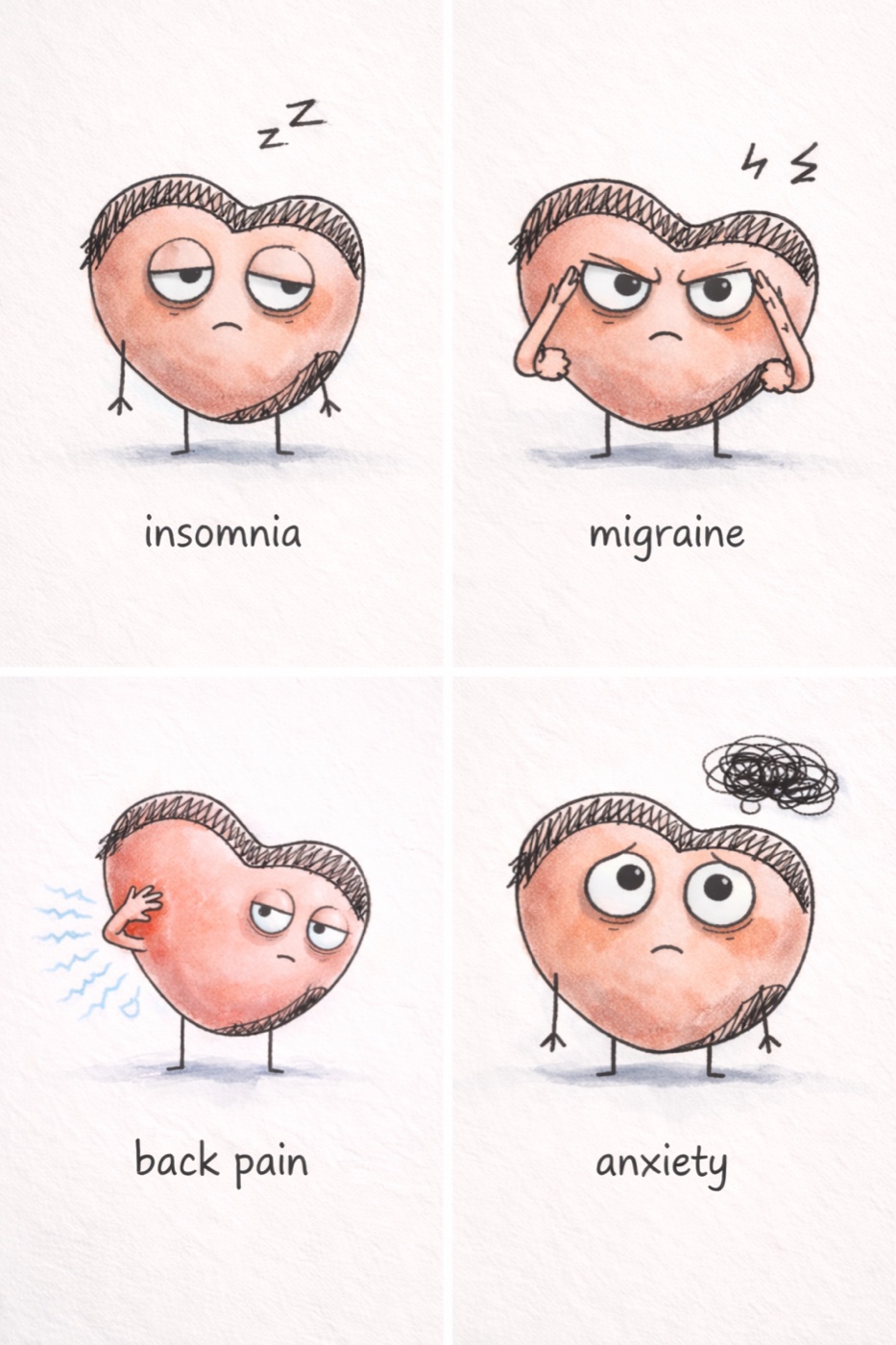
Insomnia, migraine, back pain, anxiety: areas people use Cricket for
Benefits

What studies have measured

Reported outcomes from trials, not a promise they will match your home exactly.

01Better sleep quality
02Stress and cortisol reduction
03PTSD somatic symptom relief
04Calmer stress response for some users
05Muscle pain and spasm relief
06Faster recovery and circulation
Session design

Different speeds for different needs

Labs track distinct effects at distinct speeds. We wrap those targets in natural textures (rain, bowls, night insects) so the pulse feels gentle instead of robotic.

30 Hz
Finger pads · ASD

Researchers study light finger-pad rhythms that may help some autistic children feel safer during social practice.

40 Hz
Temple · Forehead · Alzheimer's

Trials explore forehead rhythms tied to alertness and memory support for adults with cognitive decline.

80 Hz
Lower back · Chronic pain

People with stubborn lower-back pain sometimes report lower pain scores after slow mid-range sessions.

150 Hz
Jaw · ASD oral sensitivity

Therapists test jaw-area patterns to ease tension and oral sensitivity in some children.

Sound design

How we shape each session

We layer soft noise with recordings you already love (rain, bowls, night songs) so the pulse feels textured, not flat.

Each file gets gentle fades and clear labels in the Sensci app: where to place Cricket, what it is for, and how strong it runs.

Signal sources

Natural sounds used in modulation

Cricket song
Tibetan singing bowl
Rain & beach waves
Whale calls
Fire crackle
Nightingale song
Pink & brown noise
White & gray noise
In action

See a session in motion

Short clip on gentle body vibration

Research

Further reading for curious minds

1Campbell EA et al. Exploring the use of Vibroacoustic treatment for managing chronic pain and comorbid mood disorders. Nordic Journal of Music Therapy. 2019;28(4):291–314.
2Weber A et al. Evaluation of the Efficacy of Musical Vibroacupuncture in Pain Relief. Neuromodulation. 2021;24(8):1475–82.
3Bartel L, Mosabbir A. Possible mechanisms for the effects of sound vibration on human health. Healthcare. 2021;9(5):597.
4Clements-Cortes A, Bartel L. Are we doing more than we know? Possible mechanisms of response to music therapy. Frontiers in Medicine. 2018:255.
5Mosabbir AA et al. Investigating the Effects of Auditory and Vibrotactile Rhythmic Sensory Stimulation on Depression. Cureus. 2022;14(2).
6Kantor J et al. Exploring vibroacoustic therapy in adults experiencing pain: a scoping review. BMJ Open. 2022;12(4):e046591.